
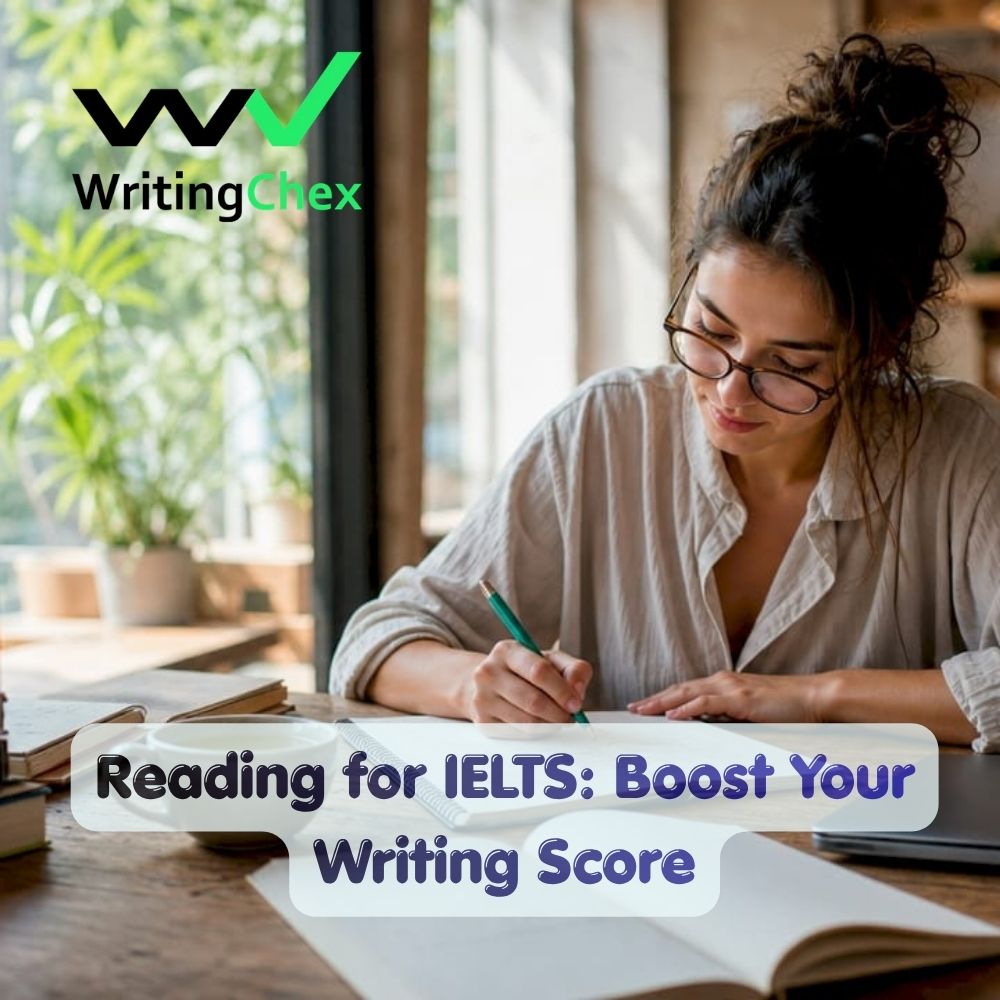
Reading for IELTS is often viewed as a separate skill—something you practise in isolation to score points on the Academic or General Training Reading paper. But this perspective misses one of the most powerful preparation strategies available to candidates.
Research confirms a significant connection. Studies have found “significantly positive correlations” between IELTS reading scores, IELTS writing scores, and overall proficiency. The University of Washington similarly points to a “clear link between reading and writing”—the more in-depth reading you do, the more in-depth writing you will produce.
So why do so many candidates treat these skills as unrelated? The answer lies in how they approach preparation. Passive reading—simply consuming texts to answer questions—yields limited returns. But strategic reading for IELTS—reading with a writer’s eye—can systematically strengthen every dimension of your writing. This article explains exactly how to make that connection work for you.
1. How Reading for IELTS Expands Your Active Vocabulary
Vocabulary accounts for 25% of your Writing score under the Lexical Resource criterion. Yet many candidates struggle to move vocabulary from passive recognition (knowing a word when you see it) to active use (deploying it naturally in your own writing).
Reading for IELTS bridges this gap. IELTS Academic Reading passages are drawn from books, journals, magazines, and newspapers—the same sources that inform high-scoring Writing Task 2 essays. When you read these texts strategically, you encounter:
- Academic vocabulary in context: Words like significant, consequently, nevertheless, and demonstrate appear repeatedly in authentic academic writing.
- Collocations: Natural word combinations such as draw a conclusion, pose a challenge, or address an issue.
- Topic-specific terminology: Environmental, technological, social, and economic vocabulary relevant to common IELTS themes.
A 2026 study found that “participant vocabulary knowledge in writing improved over the short study period” when learners engaged with embedded vocabulary through reading. This is because reading provides multiple exposures to words in meaningful contexts—far more effective than memorising lists.
Practical strategy:
- When reading IELTS passages, keep a dedicated vocabulary journal.
- Record not just the word, but the full sentence it appeared in.
- Write your own sentence using the same word in a different context.
- Review and actively use these words in your writing practice.
2. Mastering Grammatical Structures Through Reading
The Grammatical Range and Accuracy criterion accounts for another 25% of your Writing score. Examiners look for evidence that you can use a variety of sentence structures accurately—not just simple sentences, but complex and compound-complex constructions.
Reading for IELTS provides a masterclass in grammar. Academic texts are rich with:
- Complex sentences with subordinate clauses
- Passive constructions common in formal writing
- Conditional structures (if, unless, provided that)
- Varied punctuation—colons, semicolons, and dashes
When you read actively, you internalise these patterns. You begin to recognise how skilled writers vary sentence openings, use transitional phrases, and maintain grammatical consistency throughout a paragraph. This unconscious learning transfers directly to your writing.
Practical strategy:
- Select one IELTS Reading passage each week for “grammar analysis.”
- Identify five sentences with complex structures.
- Break down each sentence: find the main clause, identify subordinate clauses, note the verb forms.
- Write three new sentences using the same grammatical pattern on different topics.
3. Building Coherence and Cohesion Through Textual Analysis
Coherence and Cohesion make up another 25% of your Writing score. Coherence is about logical flow at the paragraph level; cohesion is about the linguistic links that connect sentences and ideas.
Reading for IELTS texts are masterfully organised. Every passage demonstrates:
- Clear paragraph structure: Each paragraph has a central idea, supported by evidence or examples.
- Logical progression: Ideas build on one another in a deliberate sequence.
- Cohesive devices: Transition words (however, furthermore, in contrast), referencing (this, these, such), and substitution.
- Thesis and support: The main argument is introduced and systematically developed.
By studying how professional writers organise their ideas, you learn to structure your own essays more effectively. You see how a paragraph opens with a topic sentence, develops with explanation and evidence, and closes with a link to what follows.
Practical strategy:
- After reading an IELTS passage, outline its structure.
- Identify the main idea of each paragraph.
- Note the linking words and phrases used between paragraphs.
- Practice writing paragraphs that follow the same organisational pattern.
4. Developing Ideas and Arguments for Task 2
One of the biggest challenges in IELTS Writing Task 2 is generating relevant ideas and developing them into coherent arguments. Many candidates have the language skills but lack the content knowledge to write persuasively.
Reading for IELTS builds your intellectual toolkit. The passages cover a wide range of topics—environment, education, technology, health, urban planning, culture, and economics. Each passage presents:
- Different perspectives on complex issues
- Evidence and examples to support claims
- Cause-and-effect relationships
- Problem-solution frameworks
When you read widely, you accumulate a mental library of examples, statistics, and arguments. This knowledge becomes invaluable when you face an unfamiliar Task 2 prompt. Instead of staring at a blank page, you can draw on what you have read to generate ideas and support your position.
Practical strategy:
- After each Reading passage, write a brief summary of the main arguments.
- Note any examples or data that could be used in an essay.
- Practice writing Task 2 introductions and body paragraphs on related topics.
- Challenge yourself to present counter-arguments, just as academic texts often do.
5. Mastering the Language of Task 1 (Academic)
For Academic candidates, Writing Task 1 requires describing visual information—charts, graphs, tables, maps, or processes. This demands a specific vocabulary set: language for describing trends, making comparisons, and explaining sequences.
Reading for IELTS passages frequently contain this very language. Reports and articles describe data, trends, and changes using expressions like:
- rose significantly, declined sharply, remained stable
- in contrast to, compared with, while
- the highest proportion, a substantial increase
- followed by, subsequently, over the period
The Independent article used in one IELTS blog exercise demonstrates this perfectly: “The middle-income population nearly doubled between 2001 and 2011”. By reading such texts and practising parallel sentences, candidates internalise the language patterns needed for Task 1.
Practical strategy:
- Find articles that present data (newspapers, reports, journals).
- Underline every phrase used to describe quantities, changes, or comparisons.
- Copy these sentences and write parallel sentences on different topics.
- Practice describing charts using the vocabulary you have collected.
6. Turning Reading into Writing with WritingChex
Knowing the theory is one thing; applying it is another. This is where WritingChex becomes an essential part of your preparation journey.
WritingChex is a free online IELTS writing checker tool designed specifically for learners who want to improve their IELTS writing. Here is how it complements your reading for IELTS practice:
- Personalised feedback: After you write an essay based on what you have read, WritingChex analyses your work against the official IELTS Writing criteria—Task Response, Coherence and Cohesion, Lexical Resource, and Grammatical Range and Accuracy.
- Strengths and weaknesses identified: The tool points out exactly where you excel and where you need more practice, allowing you to target your reading to address specific gaps.
- Real exam simulations: Practise with real IELTS exam simulations to get used to the test’s timing and format.
- Free forever: There is no cost barrier—you can practise as much as you need.
The cycle is simple: read strategically, write deliberately, and get feedback instantly. This iterative process accelerates improvement far more effectively than either reading or writing practice alone.
Visit writingchex.com to start turning your reading practice into higher writing scores—completely free.
7. Measuring Your Progress with WritingChex
Improvement requires measurement. Without feedback, you cannot know whether your reading for IELTS practice is actually translating into better writing.
WritingChex provides the measurement you need. The IELTS essay checker delivers:
- Detailed band-score estimates across all four writing criteria
- Specific error identification—grammar, vocabulary, coherence issues
- Actionable recommendations for improvement
- Progress tracking over time
This feedback loop is crucial. Research shows that “integrating genre analysis and sociolinguistic awareness into IELTS preparation not only improves exam performance but also fosters critical thinking and communication skills essential for real-world language use”. WritingChex operationalises this integration by connecting your reading input directly to writing output.
Here is a recommended weekly routine:
| Day | Activity | Tool |
|---|---|---|
| Monday | Read one IELTS passage; note vocabulary and structures | Official IELTS materials |
| Tuesday | Write a Task 2 essay on a related topic | Your notebook |
| Wednesday | Submit essay to WritingChex; review feedback | WritingChex |
| Thursday | Read another passage, focusing on identified weaknesses | Official IELTS materials |
| Friday | Rewrite and resubmit improved essay | WritingChex |
| Weekend | Review progress and plan next week’s focus | WritingChex dashboard |
Start today at writingchex.com and experience how structured feedback transforms your writing.
Conclusion
Reading for IELTS is not merely a test component to be conquered; it is a powerful engine for writing improvement. The connection between reading and writing is well-documented, and the IELTS data confirms that candidates who read widely and strategically tend to write more effectively.
By approaching IELTS Reading passages as learning resources rather than just question sets, you can systematically expand your vocabulary, internalise grammatical structures, understand paragraph organisation, and build a reservoir of ideas and arguments. These skills transfer directly to the Writing paper—whether you are describing a chart in Task 1 or constructing a complex argument in Task 2.
But reading alone is not enough. To maximise your progress, you need feedback. WritingChex provides exactly that—free, instant, personalised analysis against real IELTS criteria. Practice with real IELTS exam simulations, identify your strengths and areas to improve, and track your progress over time.
The data is clear: Writing consistently attracts the lowest scores globally. But this does not have to be your story. With strategic reading and the right feedback tools, you can close the gap between your Reading and Writing scores—and achieve the band you need.
Start your journey today. Read strategically, write deliberately, and let WritingChex guide you to your best score. It is completely free, forever.
Frequently Asked Questions
1. How exactly does reading for IELTS improve my writing?
Reading for IELTS improves your writing by expanding your active vocabulary, exposing you to complex grammatical structures, demonstrating effective paragraph organisation, and building your knowledge of topics and arguments. Research shows significant positive correlations between reading scores, writing scores, and overall proficiency. When you read strategically—noticing how writers use language and organise ideas—you internalise patterns that transfer directly to your own writing.
2. What types of texts should I read to improve my IELTS writing?
Focus on the same types of texts used in IELTS Academic Reading: articles from newspapers (The Guardian, The Independent), magazines (The Economist, National Geographic), academic journals, and reports. These sources expose you to the formal, academic register required for high-scoring IELTS Writing. For General Training candidates, read a broader range including newsletters, company documents, and public information texts.
3. How much should I read each day to see improvement in my writing?
Aim for 30–45 minutes of focused reading daily, combined with 20–30 minutes of writing practice. Quality matters more than quantity. One well-analysed passage is more valuable than skimming five. The key is active reading—noting vocabulary, analysing sentence structures, and observing paragraph organisation—rather than passive consumption.
4. Can reading alone get me a Band 7 in IELTS Writing?
Reading alone is unlikely to get you a Band 7. While reading builds the foundation—vocabulary, grammar, and ideas—you must also practise writing and receive feedback. Writing is a skill that requires active production and correction. Tools like WritingChex provide the feedback loop that turns reading input into writing output. Combine strategic reading with regular writing practice and targeted feedback for the best results.
5. How is WritingChex different from other IELTS writing checkers?
WritingChex is completely free, forever, with no hidden costs or usage limits. It provides personalised feedback aligned with official IELTS Writing criteria—Task Response, Coherence and Cohesion, Lexical Resource, and Grammatical Range and Accuracy. The tool includes real IELTS exam simulations to help you get used to the test’s timing and format, making it ideal for both Academic and General Training candidates.
6. How long does it take to see improvement in IELTS Writing from reading practice?
Most candidates see noticeable improvement within 4–6 weeks of consistent, strategic practice. A typical timeline from Band 5.5 to Band 6.5 requires 8–12 weeks of focused preparation. The rate of improvement depends on your starting level, the consistency of your practice, and the quality of your feedback. Using WritingChex accelerates this process by providing instant, actionable feedback on every piece of writing you submit.
7. Should I read IELTS passages before or after writing practice?
Both approaches are valuable. For optimal results, follow this cycle: Read first to gather vocabulary, ideas, and structures. Write second to apply what you have learned. Get feedback third using a tool like WritingChex to identify gaps. Re-read fourth with specific attention to those gaps. This iterative cycle—read, write, feedback, re-read—is more effective than either activity in isolation.