


Did you know that the average IELTS writing score worldwide is approximately 6.0, with many test-takers finding Task 2 particularly challenging? Statistics from recent years show that writing often lags behind other sections like listening and reading, where means are slightly higher at 6.45 and 6.32 for academic reading.
This insight highlights the need for focused preparation on IELTS Writing Task 2, where essays must demonstrate clear arguments and sophisticated language to stand out.
If you’re aiming for a higher band, starting with self-assessment is key. Check your IELTS essay for free with our AI-powered writing checker tool to get instant feedback!
In this blog post, we’ll delve into what IELTS examiners look for in Writing Task 2, breaking down the assessment criteria, providing practical examples, and sharing strategies to elevate your score.
Understanding the Four Key Assessment Criteria in IELTS Writing Task 2
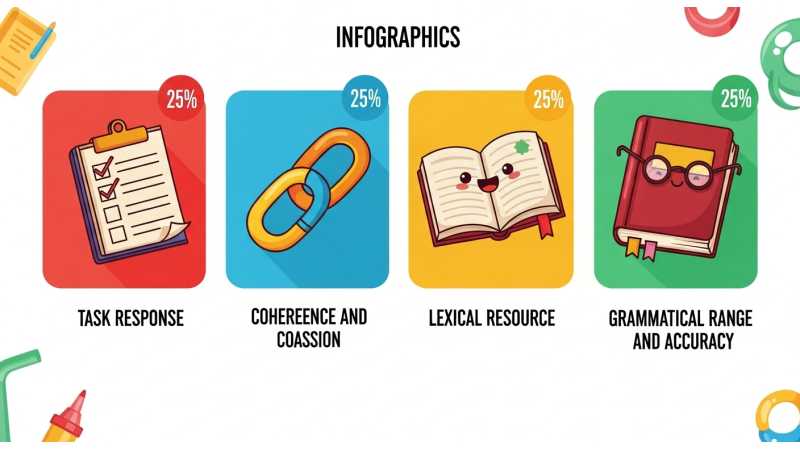
IELTS Writing Task 2 is assessed using four equally weighted criteria: Task Response, Coherence and Cohesion, Lexical Resource, and Grammatical Range and Accuracy. Each contributes 25% to your overall band score, and examiners use detailed band descriptors to evaluate your essay.
To illustrate, here’s a visual representation of a typical IELTS Writing Task 2 essay structure, which aligns with these criteria:
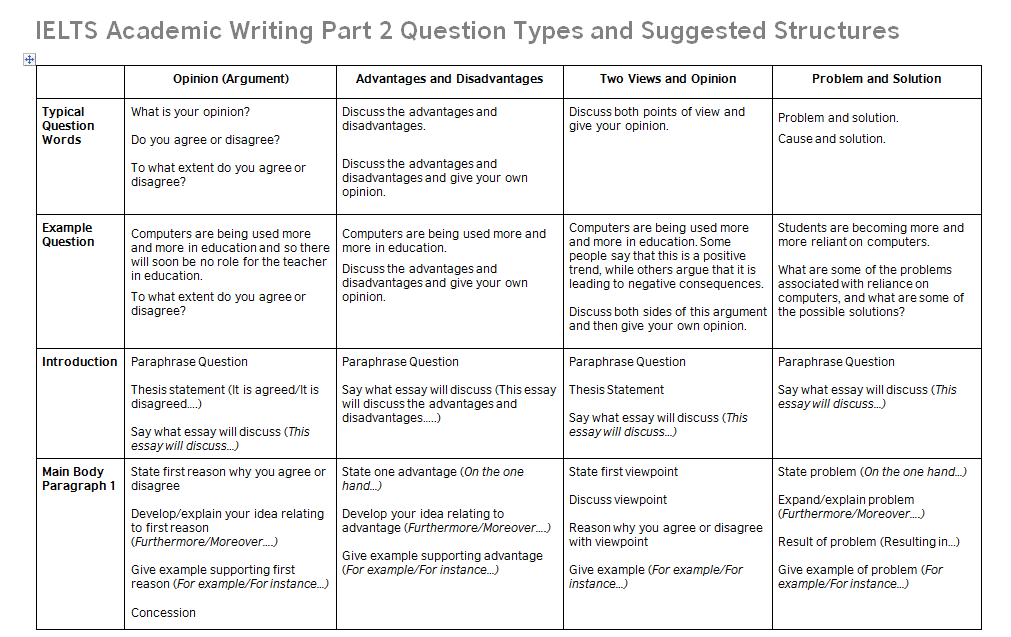
Failing to meet expectations in any one area can cap your score. For instance, global data indicates that while overall IELTS scores average 6.0-6.5, writing-specific averages often dip lower due to inadequate task addressing or poor organization.
- Task Response: Focuses on how well you address the prompt.
- Coherence and Cohesion: Examines logical flow and linking.
- Lexical Resource: Assesses vocabulary range and accuracy.
- Grammatical Range and Accuracy: Evaluates sentence variety and error-free usage.
By prioritizing these, you can avoid common pitfalls that lead to average scores.
Mastering Task Response: Fully Addressing the IELTS Writing Task 2 Prompt
Task Response is crucial as it measures how effectively you present a clear position and support it with relevant ideas. Examiners look for a direct answer to the question, with ideas extended through examples and evidence.
For a band 7, your essay must appropriately address all parts of the prompt, with a clear position and supported main ideas. In contrast, band 5 responses incompletely cover the topic, often with irrelevant details or repetition.
Consider this example prompt: “Some people think that the best way to increase road safety is to increase the minimum legal age for driving cars or riding motorbikes. To what extent do you agree or disagree?”
- A strong response would state agreement/disagreement in the introduction, then use body paragraphs to discuss reasons like maturity levels, supported by statistics such as “According to a study, drivers under 21 are involved in 20% more accidents.”
- Weak responses might digress into unrelated topics like vehicle maintenance, failing to develop the age argument.
Insights show that 30-40% of low scores stem from off-topic content, emphasizing the need for precise planning. To boost this, outline your essay in 5 minutes, ensuring every paragraph ties back to the thesis.
Achieving Coherence and Cohesion: Logical Structure in Your Essay
Examiners seek essays that are logically organized with clear progression, using a range of cohesive devices like “furthermore,” “however,” and referencing words. Band 8 requires effortless flow, while band 6 may have mechanical linking.
Statistics reveal that coherent essays score 0.5-1 band higher on average, as poor structure confuses readers.
- Use paragraphing effectively: Introduction (thesis), Body 1 (first argument), Body 2 (counter or second), Conclusion (summary).
- Bullet points aren’t suitable, but numbered steps in explanations can clarify processes.
Example: In the road safety essay, link ideas with “On the one hand… On the other hand…” to show balance. Overuse of “and” or “but” drops scores, so vary your connectors.
Practice by reviewing sample essays; many test-takers improve cohesion by 1 band through targeted exercises.
Ready to see how your writing stacks up? Try our free AI IELTS essay checker for personalized coherence feedback!
Enhancing Lexical Resource: Vocabulary That Impresses Examiners
Lexical Resource evaluates your vocabulary range, precision, and appropriateness. Examiners look for less common words, collocations, and minimal errors.
For band 9, vocabulary is sophisticated and natural; band 5 shows limited range with frequent repetitions. Data from IELTS takers indicates vocabulary issues contribute to 25% of score deductions in Task 2.
- Incorporate topic-specific terms: For environment essays, use “sustainable development” instead of “good growth.”
- Avoid over-repetition: Synonymize “important” with “crucial,” “vital,” or “essential.”
Example: Instead of “Young drivers are bad,” say “Adolescent motorists often exhibit reckless behavior due to inexperience.” This demonstrates range.
Build your lexicon by reading academic articles, aiming for 10-15 new words per topic.
Here’s an infographic summarizing band descriptors for quick reference:
Demonstrating Grammatical Range and Accuracy: Building Complex Sentences
This criterion assesses variety in sentence structures and error control. Examiners want a mix of simple, compound, and complex sentences without impeding communication.
Band 7 features flexible use with few errors; band 6 limits complexity. Studies show grammar accuracy correlates with higher overall bands, with averages rising from 5.5 to 7.0 through practice.
- Use conditionals: “If the legal age were raised, accidents might decrease.”
- Vary punctuation: Employ semicolons for related ideas.
Example: Weak: “Young people drive bad. They have accidents.” Strong: “Although young individuals may lack experience, raising the driving age could mitigate risks, as evidenced by lower incident rates in countries with stricter laws.”
Focus on proofreading to eliminate persistent errors like subject-verb agreement.
Common Mistakes in IELTS Writing Task 2 and How to Avoid Them
Many candidates fall into traps that lower scores. Examiners often note underdevelopment of ideas, leading to band 6 or below. Statistics indicate 40% of essays suffer from irrelevant examples or poor time management.
- Mistake 1: Ignoring word count – Aim for 250+ words; short essays lose marks.
- Mistake 2: Memorized phrases – Use original content to avoid detection.
- Mistake 3: Imbalanced views – In discussion essays, cover both sides equally.
Avoid by timing practice essays and seeking feedback. Real-world insight: Test-takers who revise drafts see a 0.5 band increase on average.
Tips from Top Scorers: Strategies for IELTS Writing Task 2 Success
High achievers emphasize planning and review. Band 8+ scorers often use outlines and varied examples. Data from successful candidates shows consistent practice boosts scores by 1 band within months.
- Read the prompt twice for full understanding.
- Brainstorm ideas for 2-3 minutes.
- Use real statistics sparingly but effectively – e.g., “70% of immigrants cite education as a motivator.”
Conclusion
Mastering what IELTS examiners look for in Writing Task 2 – from robust task response to precise grammar – is essential for achieving your target band. With average scores at 6.0, targeted preparation can set you apart. Implement these strategies, practice regularly, and watch your scores improve.
Don’t leave your preparation to chance – evaluate your IELTS Writing Task 2 with our free online AI essay checker tool now!
FAQs
What are the main criteria IELTS examiners use for Writing Task 2? Examiners assess Task Response, Coherence and Cohesion, Lexical Resource, and Grammatical Range and Accuracy, each equally important.
How can I improve my Task Response in IELTS Writing Task 2? Fully address the prompt with a clear position, supported ideas, and relevant examples to meet band 7+ descriptors.
Why do many get low scores in IELTS Writing Task 2? Common issues include poor organization and limited vocabulary, contributing to averages around 5.5-6.0.
Is it okay to use made-up statistics in my essay? Yes, as long as they’re believable and support your argument; examiners don’t fact-check but value relevance.
How long should my IELTS Writing Task 2 essay be? At least 250 words; aim for 280-300 to allow full development without repetition.